

London’s history often reveals incredible secrets to visitors and its own residents alike. In fact, many fascinating things that are hard to imagine modern life without originated here. For example, the city documented the opening of the first artificial ice rink, and another surprise for many is that the first roller skates were invented in the British capital. The city boasts many similar stories. However, other events were far more influential, allowing London to become one of the world’s leading economic and political centres. The opening of its first railway is one of them. What does this story reveal, and what opportunities did it bring to the city? Read more at london-future.
The Precursors and Importance of Railway Connections
In general, ideas for creating rails that carts or other wheeled vehicles could run on appeared long before England built its first railway for steam trains. Similar systems, known as wagonways or tramways, already existed in the 17th century. It would be hard to call them railways, as they were drastically different from a modern person’s idea of rail transport. However, these tracks (usually wooden) were very popular.
Firstly, they helped to avoid the constant damage to vehicles, as England had no properly laid roads at the time. Secondly, this period was characterised by the rapid development of the country’s manufacturing sector. Consequently, there was a constantly growing demand for new routes and methods of transport. These early systems involved large, horse-drawn carts transporting agricultural products, building materials, and other goods. Later, the need to transport coal arose. For this, rails became the best option. At the end of the 18th century, iron began to replace the wood used to make the rails.
A Railway That Looked Like a Film Set
Despite London’s frenetic development, the world’s first railway for steam locomotives actually connected Stockton-on-Tees and Darlington. The main reason for its construction was to transport coal from the region’s mines. However, just over ten years later, the London and Greenwich Railway was opened. Its construction involved several main stages and overcame some significant challenges. For example, a great deal of time was spent designing the section that crossed the River Ravensbourne (a tributary of the Thames), which required a lift bridge to allow ships to pass. The final stage of the railway’s construction was completed in 1838.
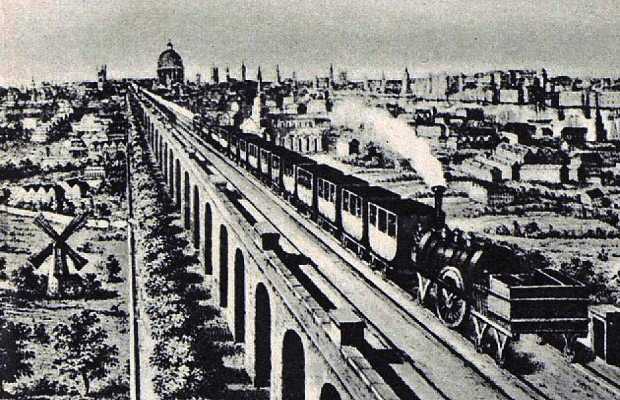
The London and Greenwich Railway had a whole range of unique features. Firstly, it was built specifically for passenger transport. Secondly, the railway was entirely elevated. However, its most striking feature was its appearance. To lay the tracks, 878 brick arches were built, forming the longest continuous viaduct in all of Great Britain. There were initial plans to build houses within these arches, but this idea was never realised. Instead, they were used for various purposes by local residents for a long time.
The railway continued to develop. Between 1836 and 1840, it carried around 1.25 million passengers per year. Throughout its history, the London and Greenwich Railway was extended multiple times. In 1864, it was extended from London Bridge to Charing Cross, and in 1866, a line to Cannon Street was added. However, one of the most significant developments was the opening of Greenwich station in 1878, which finally connected the line to Maze Hill. Overall, the construction of the London and Greenwich Railway was a monumental event. It was a symbol of technological progress and economic strength, and the railway’s unique appearance remains a part of London’s unique architectural heritage.