

Faith is a cornerstone of life in London and throughout the United Kingdom, deeply woven into the nation’s traditions. While the majority of the population historically identifies as Christian, the capital is renowned for its vast array of cathedrals, parish churches, and chapels. These landmarks are celebrated not only for their spiritual significance but also for their breath-taking architecture. However, London’s diverse tapestry also includes vibrant communities of Muslims, Hindus, and Jews, whose beliefs have left a distinct mark on the city’s architectural landscape. One standout site is the Bevis Marks Synagogue—the oldest continuously operating synagogue in the UK. What secrets does this historic gem hold? Let’s explore further at london-future.
The Dawn of a Community
Historically, the Jewish people have faced a challenging and often nomadic existence, enduring persecution and displacement across different eras. Yet, Bevis Marks Synagogue became a sanctuary that united many and helped forge a resilient community. The foundation for the synagogue was laid in the early 17th century when Marranos—Jews from Spain and Portugal—began settling in London. An informal agreement allowing Jews to relocate to England finally gave them the freedom to practice their faith openly.
As the community grew, the need for a dedicated space for worship and ceremony became urgent. In 1699, a contract was signed with Joseph Avis, a Quaker builder, to construct the synagogue. Completed in 1701, Bevis Marks played a vital role throughout the 18th century. As refugees continued to flee to London, the presence of such a building offered a profound sense of religious liberty.
Weathering the Storms of History
The synagogue’s rich history is marked by several pivotal moments. By the 19th century, the congregation had grown so large that “branch” synagogues began to open across London. One such site opened on Bryanston Street in 1866, which actually led to a sharp decline in attendance at Bevis Marks. There were even talks of closing its doors for good, but fortunately, the historic site was saved. In 1901, the building celebrated its bicentenary. While it survived two World Wars, it was tragically damaged in 1992 when an IRA bomb—the largest since WWII—was detonated in the capital. Although the Baltic Exchange was the primary target, nearly 100 people were injured, and nearby buildings were devastated. A similar blast the following year necessitated further extensive repairs to the synagogue.
Architectural Highlights
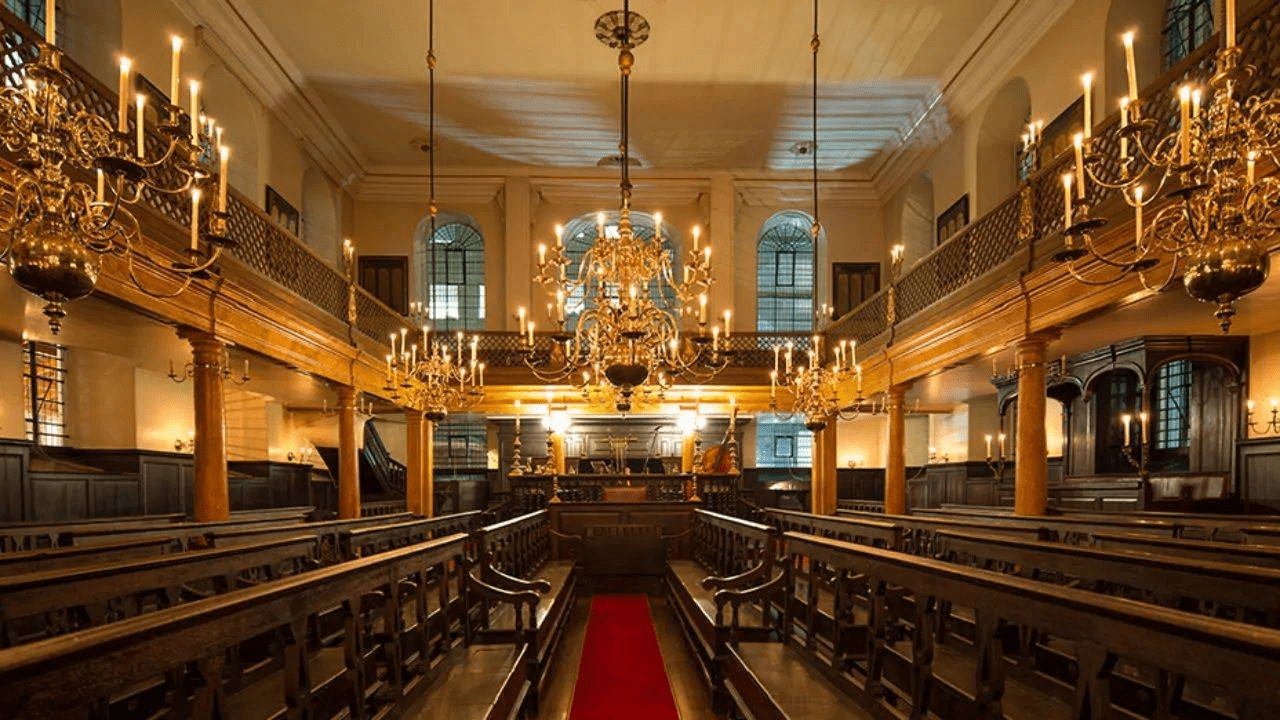
Despite its age and the trials it has endured, Bevis Marks Synagogue has remarkably preserved many of its original features. The wooden pews, arranged parallel to the side walls, are a staple of the interior; some of the backless benches in the rear even date back to 1657. However, the true showstopper is the Echal (the Holy Ark where the Torah scrolls are kept). Crafted from English oak, it was painted to resemble fine Italian marble. The interior is also adorned with seven grand brass chandeliers, symbolising the days of the week. Thanks to the large clear-glass windows, the sanctuary remains bathed in natural light, maintaining the same serene atmosphere it had over three centuries ago.