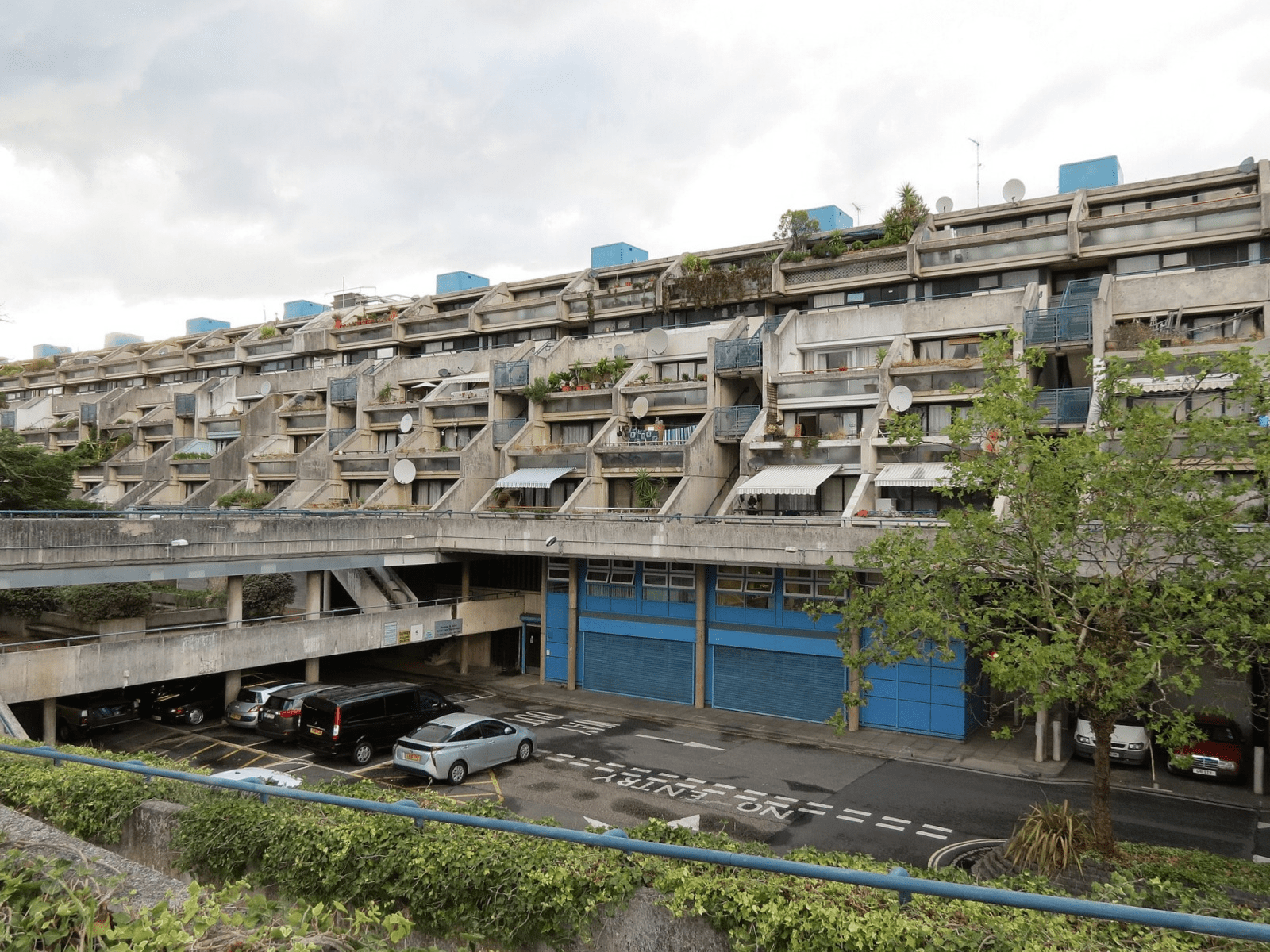
In the mid-1960s, the newly formed London Borough of Camden became a hotbed for architectural experimentation. Blending the cultural diversity of Hampstead, the intellectual atmosphere of Holborn, and the working-class energy of St Pancras, the area aimed to pioneer a new model of urban living. It was here that one of the most ambitious housing projects in the UK was born: the Alexandra Road Estate. Read more on london-future.
The History and Development of Alexandra Road Estate
Planning for the Alexandra Road Estate began in the late 1960s. In 1968, the development concept was unveiled, immediately sparking a great deal of debate. Camden’s planning department raised concerns that a low-rise scheme wouldn’t provide the necessary housing density for the area. However, the project’s lead architect, Neave Brown, managed to convince officials of his vision’s viability by proposing a series of innovative solutions. Construction was finally completed in 1978, at a cost of over £20.9 million.
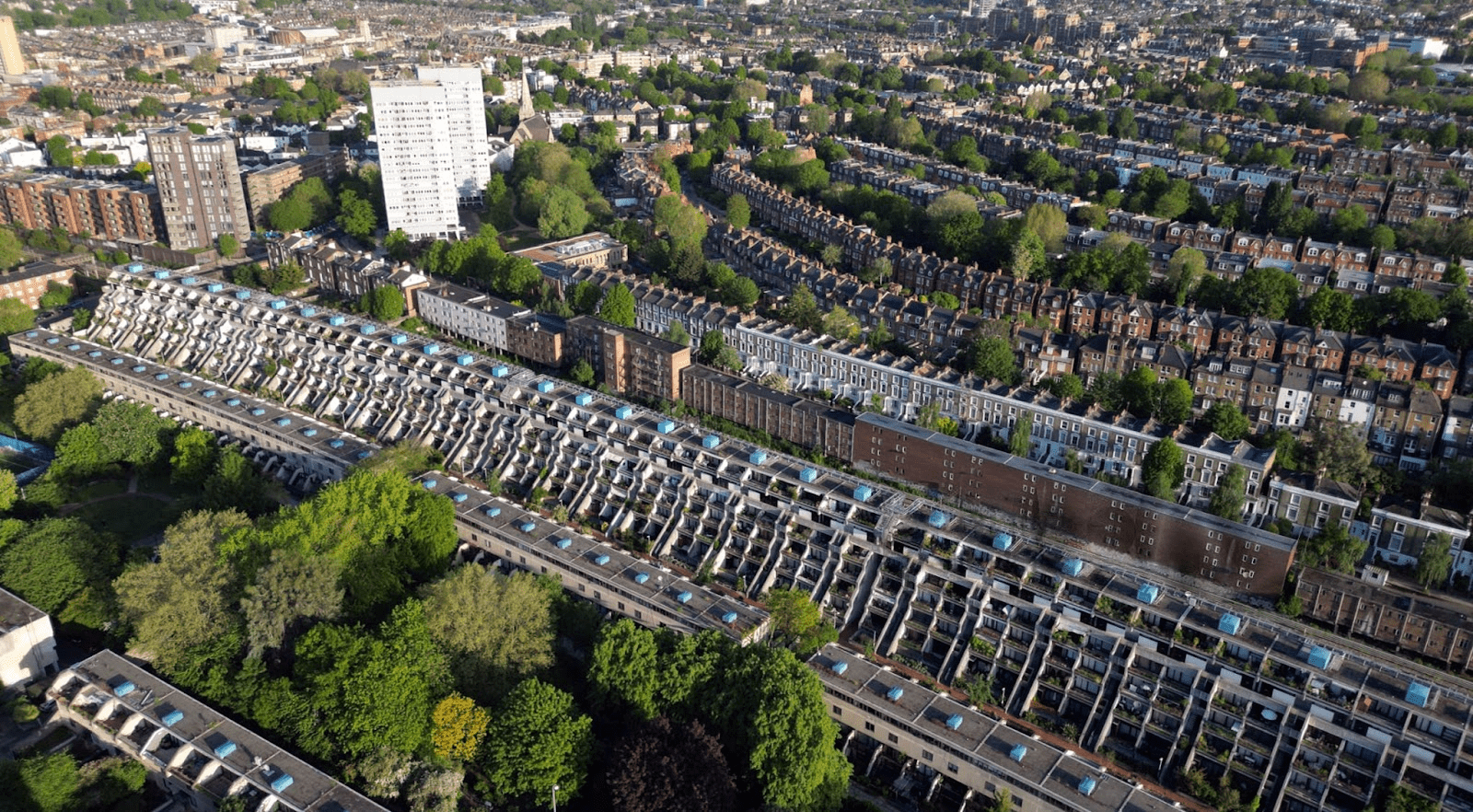
Brown’s goal was to create a new kind of urban living that combined high-density housing with a sense of community. He was inspired by the atmosphere of traditional English streets, where every resident has their own ‘front door’ but also lives in close interaction with their neighbours. As a result, all flats in the Alexandra Road Estate were given direct access to the complex’s central street and had a private outdoor space, such as a terrace or a roof garden. Additionally, the architectural design had to account for the nearby railway line, so the massive blocks were partly built to act as a noise barrier.
The Alexandra Road Estate features three main residential blocks. The largest is eight storeys high, while the other two are four-storey buildings with flats opening onto terraces and green gardens next to a four-hectare park. In total, the estate has 520 flats of various sizes, ranging from one-bedroom to spacious four-bedroom units. The area was also designed from the outset as a self-contained urban hub, with a school, a children’s club, a youth centre, car parks, and recreational areas all built on site.
The 1980s marked a turning point for the Alexandra Road Estate. With the arrival of Margaret Thatcher’s government and the introduction of rate capping, the funding system for council housing underwent a dramatic change. Designed to be high-maintenance and requiring constant care, the building quickly began to show its age. The concrete proved to be extremely vulnerable to moisture and weather exposure, leading to cracks and discoloured surfaces that required expensive upkeep. To make matters worse, the central heating system worked erratically, with some residents complaining of cold flats while others were too hot.
In the late 1980s, residents decided to take matters into their own hands. Frustrated with the ineffective repairs, they launched a campaign for the complex’s restoration in 1989. The movement was led by Elizabeth Knowles and Christopher Dean from DOCOMOMO, an international organisation dedicated to preserving modernist architecture. The campaign proved to be incredibly successful, and in 1994, the Alexandra Road Estate was granted Grade II listed status.
Recognition and Legacy of Alexandra Road Estate
The Alexandra Road Estate is now widely regarded as a cultural and architectural landmark in London. Conceived by Neave Brown in the 1960s as a new model for high-density urban development, it became the culmination of his experiments in combining social integration, spatial freedom, and innovative architectural solutions. Ultimately, the estate has become an icon of British Brutalism and one of the most important examples of social housing in Europe. Despite technical challenges and periods of neglect, it has earned international recognition, becoming a cultural heritage site and a symbol of the post-war era of housing reforms. Today, the complex is featured in exhibitions, studied at universities, and recognised in the media around the world.