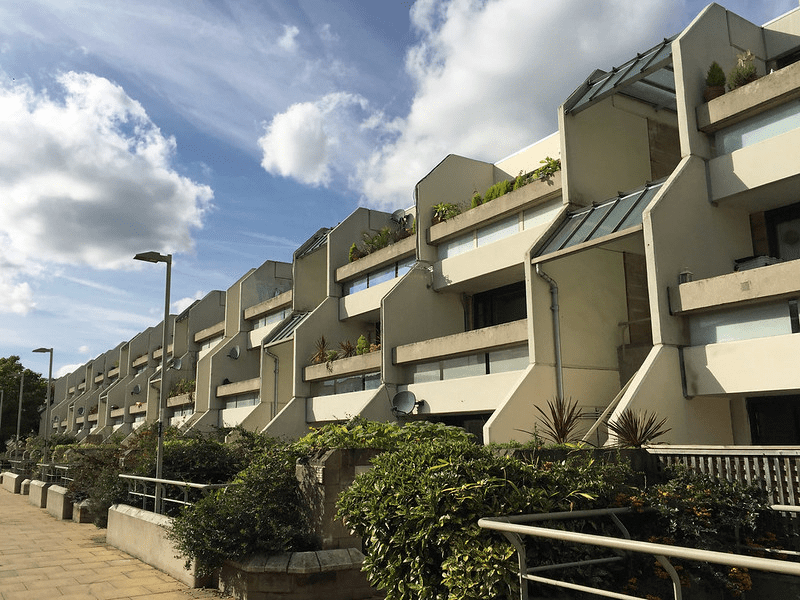
In the 1960s, Camden became a hub for architectural and social experimentation in London. With a progressive, justice-oriented approach, the local council sought to eradicate slums and replace them with high-quality council housing. One of the hallmarks of this movement was the Whittington Estate, a complex that blended modernist aesthetics, low-rise design, and a focus on community building. This article explores its history and significance. Read more on london-future.
The Story Behind the Whittington Estate
During his time at Regent Street Polytechnic in the 1960s, a young Hungarian-born architect named Peter Tabori began working on a housing estate as part of his diploma project. He gained valuable experience with renowned architects, first with Richard Rogers and later with Ernő Goldfinger. However, it was his collaboration with Camden’s Borough Architect, Sydney Cook, that proved to be a turning point. It was then that he proposed the concept for the Whittington Estate, which was later brought to life under the guidance of the Department of Technical Services.
The journey from concept to completion, however, was far from smooth. Construction began in 1972 and was scheduled to finish by 1974, but the initial contractors struggled with the pre-cast concrete technology. Then, in 1976, the development company went bankrupt, leaving behind defective structures that had to be partially demolished and rebuilt. As a result, the cost of the complex soared to over £9 million, more than double the original estimate. The project was finally completed in 1979.
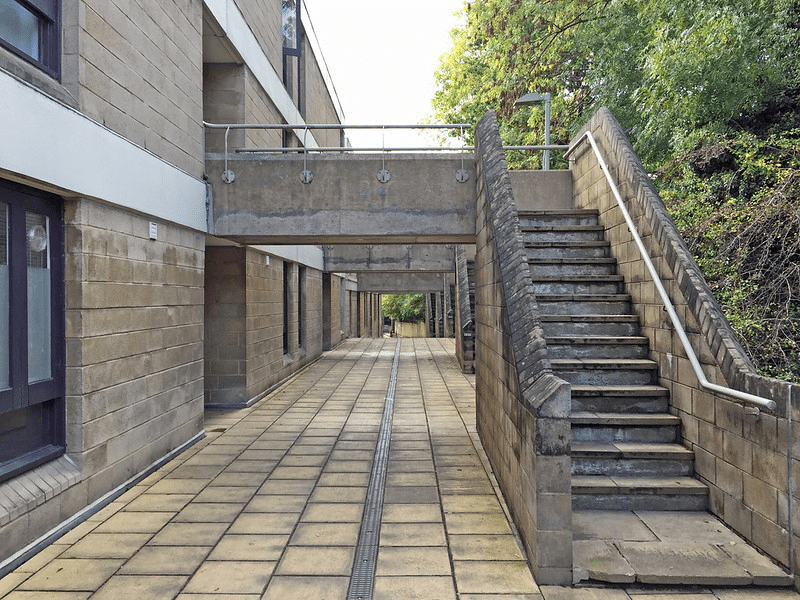
Despite these setbacks, the Whittington Estate was a true architectural experiment. Peter Tabori’s organic, brutalist design offered a striking contrast to the dilapidated Victorian houses that once occupied the site. The complex was built with a strong commitment to social unity and an ecological approach to urban planning. Its pedestrian walkways were designed as “green corridors,” with each of the four paths featuring a unique array of trees and plants to help with orientation and add variety to the urban landscape. Children’s playgrounds were also included to foster an active and safe environment.
A key feature of the Whittington Estate is its six-level terraces, which create bold horizontal lines and ensure every flat receives ample natural light. The 271 homes each have private, south-facing balconies or courtyards, making the spaces feel open and sunny. The layouts were thoughtfully planned, with kitchens opening directly onto pedestrian walkways and playgrounds, creating a sense of seamlessness between indoor and outdoor living. The interiors were designed for flexibility, with moveable partitions and panels that allowed residents to reconfigure rooms to suit their needs.
Yet, the project wasn’t without its flaws. The underground car park, which provided a single space for each flat, was one of the less successful design choices. The original plan to bring natural light into the underground spaces and create multiple additional entrances also fell through. Despite these challenges, the architectural value of the Whittington Estate has not gone unnoticed. In 2020, The Twentieth Century Society (C20) put forward an initiative to grant it listed status, preserving it as a significant cultural heritage site.
The Legacy of the Whittington Estate
The Whittington Estate is celebrated as a prime example of the innovative social housing created by the Camden Council during the 1960s and 70s. Its concept demonstrated that municipal architecture could combine high-density living with a humane scale, green spaces, and a high-quality urban environment. With its low-rise, ziggurat-like terraced houses, well-planned pedestrian areas, and intelligent use of landscaping, the complex embodied the ideals of modernist urbanism and the desire to create a true sense of community.