
What began as a simple fascination with the night sky and a passion for capturing images of distant galaxies has evolved into a serious academic pursuit for Guy Wells and Daniel Bamberger. The fruit of their labour is the Northolt Branch Observatory, an establishment that proves a small team of amateur astronomers with limited resources can make a significant impact on global science, making discoveries and contributing to international space research. Read more on london-future.
The Genesis and Growth of the Northolt Branch Observatories
In an interview, amateur astronomer Guy Wells shared how he began his journey into astrophotography by focusing on well-known celestial objects like planets, nebulae, and star clusters. One day, he serendipitously captured the dwarf planet Pluto in his photos. This discovery captivated him, leading him to actively monitor how the celestial body changed its position over several nights.
In 2015, Wells and Bamberger founded the Northolt Branch Observatory, an extension of the Northolt Branch Astro, a local initiative that brought together astrophotography enthusiasts. In the early days, they faced a myriad of challenges: technical issues with equipment, unstable software, and an imperfect observation system. Their initial setup, in particular, was unable to effectively track asteroids, even in suitable conditions.
However, the enthusiasm and persistence of the Northolt Branch Observatory team paid off. In 2018, they acquired a new QHY42 scientific camera, which significantly improved the sensitivity and accuracy of their observations. It was during this period that the asteroid 2010 WC9, which was set to approach Earth on May 15, 2018, at a distance of just 203,453 km, caught the attention of the astronomical community. Although the celestial body was too dim to be seen with the naked eye, the observatory team live-streamed telescopic images on their Facebook page. This initiative allowed the public to witness the asteroid’s close approach in real-time.
In April 2020, members of the Northolt Branch Observatory detected an object that was initially classified as the asteroid 2020 GL2. They then submitted the data to the Minor Planet Center (MPC). While it initially seemed like another new asteroid discovery, it was soon realised to be a mistake. Further research revealed the object was actually BepiColombo, a joint mission between the European Space Agency (ESA) and the Japanese agency JAXA, on its way to Mercury. Although the original record for 2020 GL2 was later removed from the MPC catalogue, the images of BepiColombo went on to win an informal competition for the “best track” of a spacecraft.
But it’s not just spacecraft that are in the sights of the Northolt Branch Observatory—potentially hazardous celestial bodies are also on their radar. On December 27, 2024, ATLAS, an automated system for warning about asteroid collisions with Earth, detected an object designated 2024 YR4. Based on the available observations, Daniel Bamberger was able to pinpoint the possible impact zone and date. If the event were to happen, 2024 YR4 could enter Earth’s atmosphere sometime on December 22, 2032, along a long arc.
Recognition and Impact of the Northolt Branch Observatories’ Work
In recent years, the Northolt Branch Observatory team has confirmed approximately 200 new asteroids and made over 6,500 measurements of small solar system bodies. Their observations cover both natural and artificial objects, including the ESA spacecraft BepiColombo, whose images earned the team a win in an informal ESA competition. Another key aspect of the observatory’s work is its close collaboration with astronomical equipment manufacturer QHY. The team not only actively uses QHY cameras but also helps improve them through their hands-on experience.
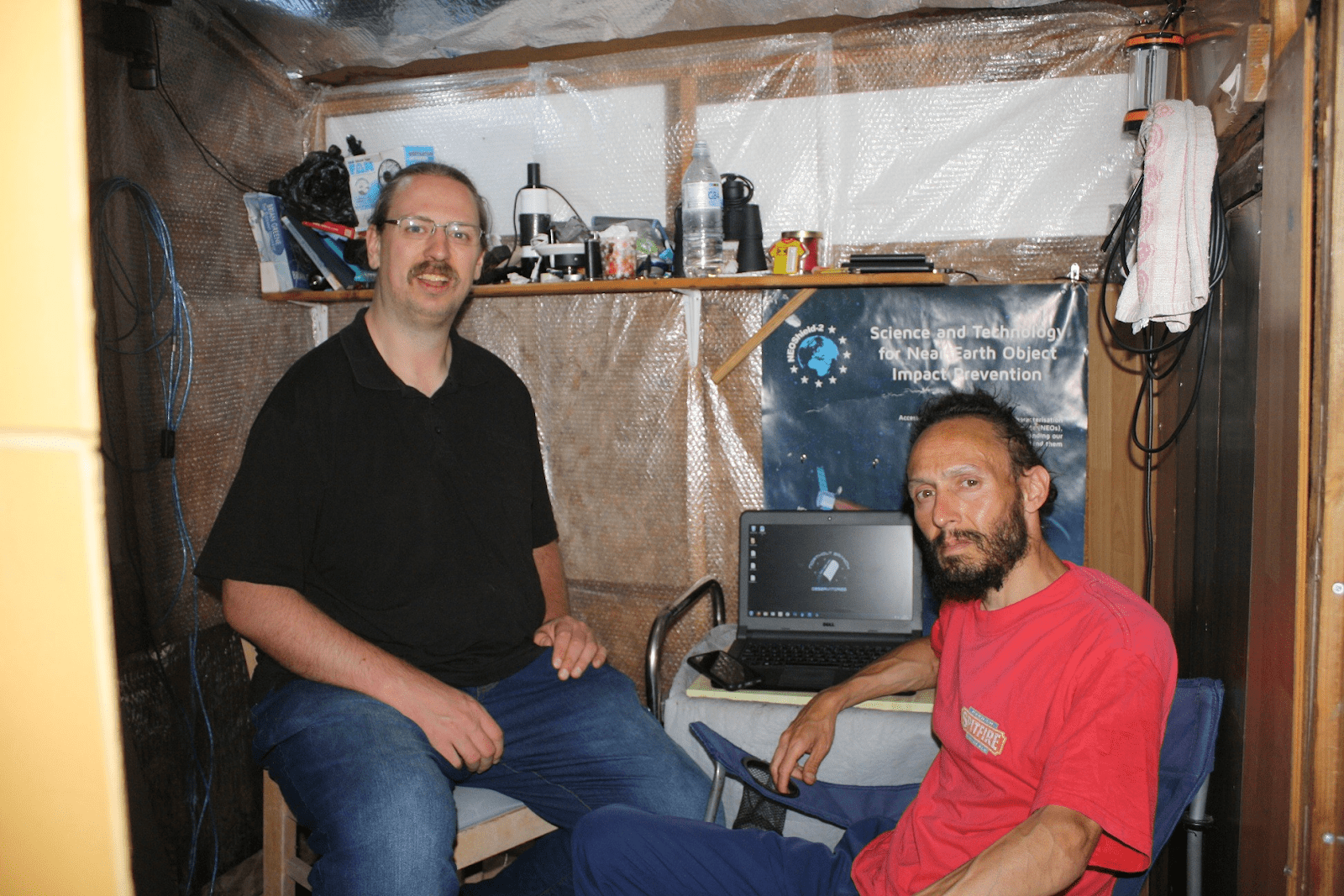
Daniel Bamberger and Guy Wells

