

The arrival of the Underground and the creation of its many stations is, perhaps, one of the most significant stages in London’s history. In the modern world, underground rail transport plays a vital role, as it’s one of the best ways to avoid traffic jams and heavy congestion. For the British capital, a city that is always bustling with life, its presence is essential. Tube stations are constantly being improved and modernised, which makes the development history of an individual station all the more interesting to explore. Blackhorse Road station, for example, serves as a good reflection of the Underground’s transformational journey. Its story begins in the late 19th century and holds many interesting facts. Read more at london-future.
A History of its Development
The first interesting fact about Blackhorse Road’s history is that its opening transformed the surrounding area. The district where the station was built could hardly be called part of the city. It was more like a quiet suburb where people lived peaceful lives, primarily engaged in agriculture. However, from 9 July 1894, radical changes began. The station’s opening (as part of the Tottenham and Forest Gate Railway) provided new opportunities for the development of a fully-fledged industrial area. Several factories and other small businesses were established here. In 1902, the station was jointly controlled by the Great Eastern Railway and the Midland Railway, and after the Second World War (in 1948), it was transferred to British Railways ownership.
Transport links in the area were expanded in 1968. On 1 September, the Victoria line station was opened. It was essentially part of the same Blackhorse Road station. It couldn’t boast a large size and had only two platforms, but it was an important step towards improvement. Blackhorse Road’s history also includes times when train services were suspended. For example, in the early summer of 2016, passenger services were halted for a project involving bridge restoration, platform extensions, and other similar modernisations. During this period, a rail replacement bus service was in operation on this section. The work was completed in February 2017.
Key Features and the Station Today
Blackhorse Road is an interchange station on the Victoria line and the penultimate station on its north-eastern branch. The station’s layout is not very complex. It consists of two platforms for the Victoria line and two for the London Overground. There are waiting areas on the station premises, but no formal waiting rooms. You can also buy drinks and use the services of small shops here. Furthermore, there are facilities for people with disabilities. These include induction loops, ramps, and tactile paving on the platforms. However, it should be noted that there are no specially equipped accessible toilets. The station has a large number of ticket barriers that control access to all platforms. This system is also designed to serve passengers with Oyster cards. They must be touched on the yellow card readers. There is also an opportunity for pass holders to receive a fare discount. To do this, a person interchanging between lines must touch their card on one of the pink card readers.
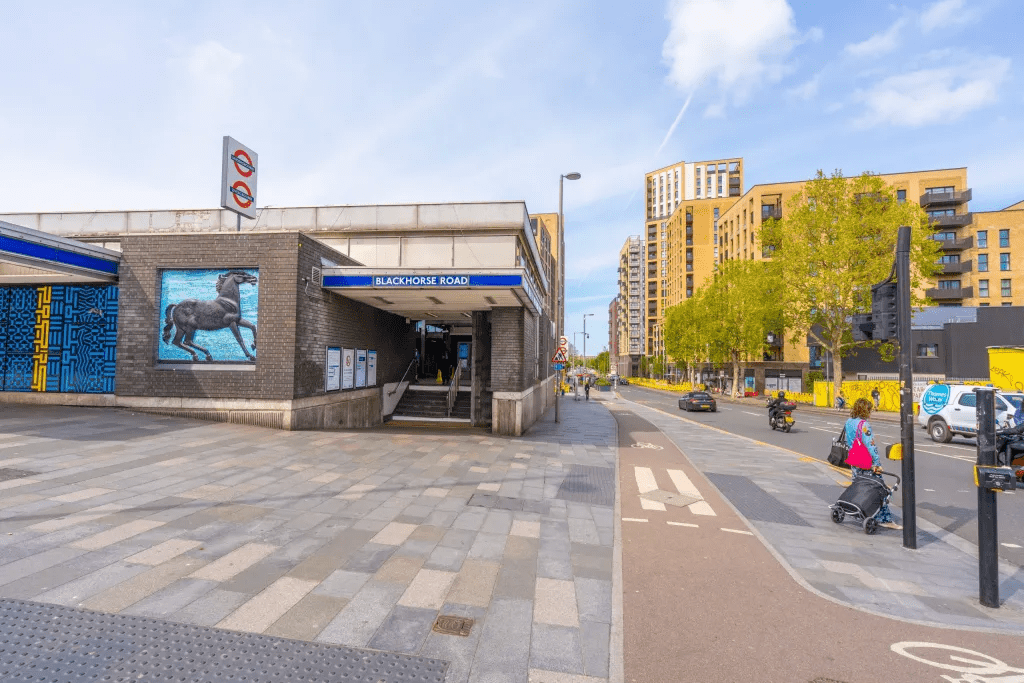
A distinctive feature of Blackhorse Road is the artwork that adorns the building’s walls. The main element in both pieces of art is a horse. They highlight the station’s name and serve as its symbols. The first, a relief panel which can be seen near the entrance, was created by the Scottish sculptor David McFall. The other work is by Hans Unger. It is a tile motif characterised by the image of a black horse on a light blue background.