

St Marylebone Parish Church is an Anglican church located on Marylebone Road in London. The church has a grand history that dates back several centuries. It has become not only a spiritual place but also a historical symbol of the Marylebone area. Learn more at london-future.
The church is beautiful and famous for its architecture and decoration, reflecting the era of creation. It was built according to the design of Thomas Hardwick in 1813-1817. This location has become very popular among local residents and tourists.
History of creation
The history of the church lasts for more than 900 years. It has long been famous for its musical and liturgical perfection. The first church was built near Oxford Street in 1200, but it was demolished in 1400. A new one was built near the existing chapel. The bishop wanted the old churchyard to be preserved and also gave permission to create a cemetery on the new site. The church was dedicated to the Virgin Mary.
The population and the parish along the Tyburn River were increasing and the church had to be completely rebuilt in 1740-1742. It became smaller and gave the name to the Marylebone area.
The new long brick church with a bell tower in the west end was opened in April 1742. Inside, there were galleries on three sides and even monuments from the old church. The church didn’t stand the test of time too and had to be rebuilt. In 1818, it became a parish church.
Architectural solutions
The church in its modern appearance was built in 1817-1819 in the then-popular neoclassical style. It features elements of Greek architecture, including large columns and an elegant facade as well as the interior with arches and decorations in light colours. Therefore, it is considered an architectural masterpiece.
The church is decorated with stained glass windows showing biblical scenes and angels. There are also commemorative plaques dedicated to historical figures who lived in the area. Due to its architectural features and beautiful interior, the place has become a favourite venue for weddings, church services and even musical events.
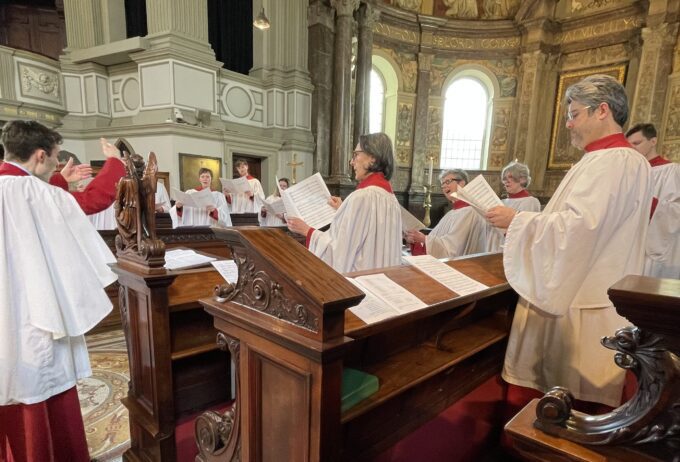
Source: stmarylebone.org
World War II bombings destroyed the stained glass windows. However, they were restored after the end of hostilities. People still admire them today. The crystal chandeliers were moved here from the old meeting room of the Marylebone Town Hall in 1968. The church has the Browning Room named after the wedding of poets Robert Browning and Elizabeth Barrett, which took place here on September 12, 1846. It has a stained glass window donated by the Browning Society in Winnipeg. That marriage became the most romantic story of the period.
The room also has two copper bas-reliefs depicting the poets and various objects associated with them. There is also a bas-relief of the Rev Charles Wesley, who is buried in the church cemetery.
Cultural significance
St Marylebone Parish Church has always attracted attention with its musical traditions. Today, a professional choir of 10 voices is supported by a music director, an assistant music director and an organist. Sir John Stainer wrote The Crucifixion oratorio for the church in 1886. It has been performed annually since then.
The modern parish church is a place of prayer and spiritual renewal for many Londoners. It hosts concerts and social services. The church has a tradition of participating in charitable events that support the needy, lonely and homeless.
The church is a cultural centre of the Marylebone area because, besides services, people come here to learn about its architectural history. It’s not just a building, it’s a place of great power, inspiration and cultural heritage.