

As London’s rich history is celebrated worldwide, it is well worth remembering the incredible buildings that were once part of it but no longer exist today. Baynard’s Castle was one such landmark. Generally, London’s architectural history is a fascinating subject, filled with a wealth of unique structures. Although the city authorities and residents strive to preserve this heritage by all possible means, several remarkable buildings have been lost to the tides of history. While Baynard’s Castle is gone, its story remains well-known. What was its significance to the British capital? What were its defining features, and what secrets does its history hold? Read more at london-future.
The Norman Conquest and the Castle’s Origins
The story of Baynard’s Castle began in 1066, following the Norman Conquest. The castle’s name dates back to this period, closely associated with the era of William the Conqueror. The structure was built to allow the invaders to maintain control over the city and suppress any potential local uprisings. Baynard’s Castle was one of three Norman fortifications in the capital. It was situated on the site now located between Blackfriars Station and St Paul’s Cathedral.
Changing Status and Successive Destructions
The Norman-built structure stood for several centuries, during which time it frequently changed hands. In the 12th century, King Henry I granted Baynard’s Castle to the nobleman Robert Fitz Richard, after which it was passed down through his descendants. Eventually, the property came into the possession of Robert Fitzwalter. This marked the beginning of a turbulent chapter. Fitzwalter was a leader of the baronial opposition against King John. According to some legends, the King set his sights on the baron’s daughter, and by opposing the crown, Fitzwalter was defending her honour. While it is not known for certain if she was the primary cause, the baron’s activities forced the family to flee the country, and King John ordered the destruction of Baynard’s Castle in 1213. By the summer of that same year, the baron managed to reclaim his estates, and the castle was subsequently rebuilt.
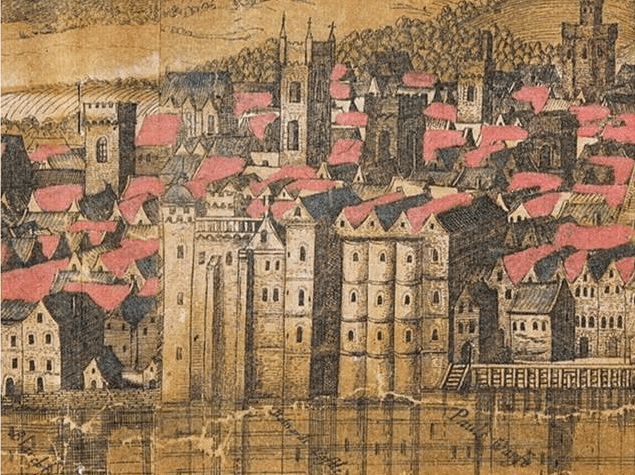
The baron’s descendants sold the building in 1275, marking a pivotal stage in its evolution. Baynard’s Castle was relocated and rebuilt on a different site, closer to the river. Today, many famous structures line the banks of the Thames, each unique and connected to various aspects of city life. However, for the London of that time, Baynard’s Castle remained one of the grandest buildings, serving as a symbol of power, wealth, and prestige. In the 16th century, Henry VII transformed the castle into a palace. These changes reflected a shift in character, making the building more suitable for entertainment. It became a renowned venue for spectacular events and was a well-known royal residence, often housing the King’s consorts.
Architectural Features
Details regarding the building’s unique features came to light following excavations carried out between 1972 and 1975. Archaeologists discovered the remains of two of the castle’s walls. One likely served as a curtain wall (the defensive wall between two flanking towers), while another replaced it after 1428. The foundations of Baynard’s Castle were constructed from chalk and stone. Key architectural highlights included a gatehouse tower and a cobbled entrance from Thames Street. As for the end of the castle’s story, it was destroyed by the Great Fire of London in 1666. The only small part of Baynard’s Castle to survive slightly longer was a single tower.