

London has long stood as a global icon, a palimpsest of history where every cobblestone tells a story. To truly understand the capital of the United Kingdom, one must look beyond the famous landmarks and delve into the narratives woven into its streets. Each thoroughfare is unique, serving as a silent witness to the passage of time. Over the centuries, these pavements have been graced by the footsteps of aristocrats, the arrival of politicians in their sleek motorcars, and the quiet moments of lovers admiring the Thames. They have been playgrounds for children and bustling arteries for the everyday Londoner hurrying about their business. Furthermore, London’s streets are defined by the structures that line them, each reflecting a different era of urban evolution. Consider the transformation of Carnaby Street, which evolved from a collection of modest workshops and neglected alleyways into a world-renowned fashion hub. This evolution proves that every street demands a closer look; given time, they will eventually surrender their secrets. But what exactly does Cleveland Street hide, and why is its reputation so inextricably linked to one of the most provocative scandals of the Victorian era? The answers lie deep within the archives of london-future.
The allure of London’s West End often masks the darker chapters of its past. While the city is celebrated for its progress and culture, its history is also punctuated by moments of profound controversy that once threatened the very foundations of the British establishment. Cleveland Street, situated in the heart of Fitzrovia, is a prime example of such a location. Today, it may seem like a typical, albeit charming, central London street, but beneath its modern surface lies a narrative of power, secrecy, and social upheaval that continues to fascinate historians and locals alike.
A Tale of Two Parishes: The History of the Street
Cleveland Street occupies a significant position in London’s geography, and its history is as layered as the city itself. As far back as the 16th century, the street served as an unofficial boundary between two distinct administrative areas: the western parish of Saint Marylebone and the eastern parish of Saint Pancras. This “borderline” status often meant that the street had a unique character, existing between two worlds. Over the following century, the nomenclature of the area underwent several shifts. For a considerable period, this stretch was known as Green Lane, a name that evokes a much more rural and pastoral image than the urban landscape we see today. During this era, the territory was characterised by the presence of grand palaces and stately residences, reflecting the aristocratic ambitions of the developing city.
The name “Cleveland Street” itself carries a weight of nobility and intrigue. It is widely believed to have been named after Charles FitzRoy, the 2nd Duke of Cleveland, who was the illegitimate son of King Charles II and his mistress, Barbara Villiers. The street formed part of the extensive landholdings belonging to the FitzRoy family, a lineage that held immense influence over the development of this part of London. As Charles FitzRoy inherited the property, the street was formally integrated into the family’s estate, cementing its connection to the upper echelons of British society. However, despite these noble origins, the street’s most enduring fame would not come from its aristocratic landlords, but from the events that unfolded within one particular building during the late 19th century.
In the mid-Victorian period, Cleveland Street was a place of contrasts. While it maintained its prestigious connections, it was also a bustling hub of industry and residence for the burgeoning middle class. Small businesses, tailors, and artisans lived alongside the wealthy, creating a vibrant social tapestry. Yet, it was this very mix of social classes that provided the perfect cover for clandestine activities that would eventually lead to a national crisis. The street’s layout, with its narrow alleyways and discreet entrances, offered the anonymity required for those seeking to engage in activities deemed illicit by the moral standards of the day.
The Shadow of the Law and the Infamous Number 19
To understand the magnitude of the scandal that would later define Cleveland Street, one must consider the legal and social climate of the late 1800s. A pivotal moment occurred in 1885 with the passing of the Criminal Law Amendment Act. This legislation was ostensibly designed to protect women and minors, but it contained a notorious “Gross Indecency” clause. This clause effectively criminalised all forms of male homosexual activity, providing the state with the tools to persecute the LGBT community with unprecedented severity. In an era where such behaviour was viewed by the public as “abominable” and “unnatural,” the Act became a weapon used to enforce a rigid moral code. However, a question remained: would these draconian measures be applied equally to the working class and the untouchable aristocracy?
The answer began to emerge in 1889, quite by accident. The uncovering of the Cleveland Street scandal was not the result of a coordinated sting operation, but rather a stroke of luck during a routine investigation. The police were initially looking into a series of small thefts involving messenger boys from the General Post Office. During an interview with a young boy named Charles Thomas Swinscow, investigators were surprised to find him in possession of an unusually large sum of money—equivalent to several weeks’ wages. Under questioning, the boy eventually confessed that he had earned the money at a male brothel located at 19 Cleveland Street. This revelation sent shockwaves through the police department, as it pointed to a hidden network of vice operating right under their noses.
As the investigation deepened, the full scale of the operation became clear. The brothel, run by a man named Charles Hammond, catered to a very specific clientele. While the police were gathering evidence, Hammond managed to evade capture, fleeing across the English Channel to France. This escape raised eyebrows, suggesting that he may have been tipped off by someone within the authorities. When the scandal finally broke in the press, the details were sensational. It was revealed that the brothel’s regular patrons included some of the most prominent figures in British high society. Among them was Lord Arthur Somerset, an equerry to the Prince of Wales (the future King Edward VII) and a close associate of Prince Albert Victor, the second in line to the throne.
The involvement of Lord Arthur Somerset turned a local police matter into a national political crisis. Government officials and high-ranking members of the establishment were suddenly faced with a dilemma: uphold the law and risk a scandal that could topple the monarchy, or orchestrate a cover-up. By the time formal warrants were issued, Somerset had also fled the country, eventually settling in the South of France. The British and American press had a field day, with newspapers reporting on the “Cleveland Street Horror” for months. Despite persistent rumours that Prince Albert Victor himself—affectionately known as “Prince Eddy”—had visited the establishment, no formal charges were ever brought against the royals. The aristocracy remained largely shielded from the consequences of the law, and over time, the scandal was quietly hushed up, though it left an indelible stain on the street’s reputation.
From Victorian Vice to Modern Landmark
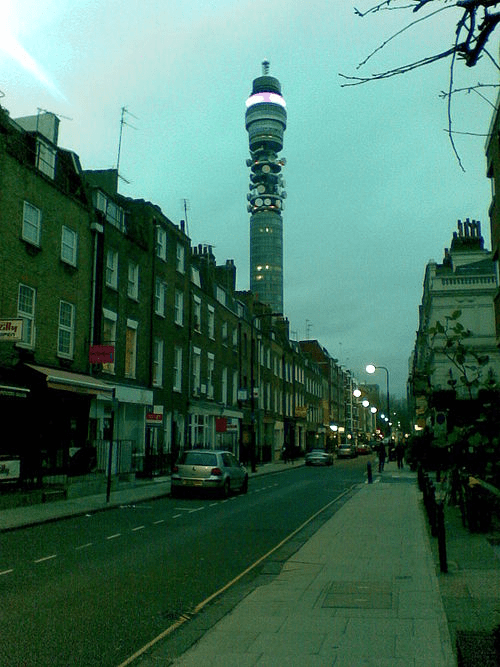
In the 21st century, Cleveland Street has shed its scandalous skin, emerging as a site of immense historical and architectural significance. It is a place where the literary past meets the technological future. One of the street’s most celebrated residents was none other than Charles Dickens. The legendary author lived at number 22 (then known as 10 Norfolk Street) during two formative periods of his life. Historians believe that his time here, living just a few doors down from the Cleveland Street Workhouse, profoundly influenced his writing. The grim reality of the workhouse likely provided the inspiration for the suffering of Oliver Twist, making the street a cornerstone of English literary history. The building at number 22 stands today as a testament to Dickens’ enduring connection to the area.
However, the modern skyline of Cleveland Street is dominated by a very different kind of landmark: the BT Tower. Rising to a height of 177 metres (581 feet), this iconic telecommunications tower was the tallest structure in London from its completion in 1964 until 1980. Its futuristic, cylindrical design stands in stark contrast to the Victorian brickwork that characterises much of the street. Originally known as the Post Office Tower, it served as a vital hub for Britain’s communications network during the Cold War. Today, it remains a Grade II listed building and a symbol of London’s mid-century modernism. The presence of the tower serves as a reminder of how much the city has evolved, moving from the whispered secrets of the 19th century to the global communication age.
Cleveland Street is a microcosm of London itself—a place where the scandalous, the noble, the literary, and the technological all converge. Whether you are walking past the site of the old workhouse, admiring the blue plaque on Dickens’ former home, or looking up at the towering height of the BT Tower, you are surrounded by stories. The street has successfully transitioned from a site of Victorian infamy to a cherished part of the city’s heritage. It reminds us that history is never far away, and even the most ordinary-looking streets can harbour extraordinary tales. Today, Cleveland Street continues to impress visitors not just with its architectural diversity, but with the sheer depth of its historical narrative, proving that some secrets are simply too big to remain hidden forever.