

London’s history is filled with significant events. The unveiling of new landmarks has always been a momentous and symbolic occasion for the city. These landmarks have varied in appearance and purpose, but their arrival has always signified the British capital’s unstoppable development. Time itself plays a crucial role in the life of every city and humanity as a whole. While it is often the subject of philosophical debate, time found its material form in the clock. If you look at this through the lens of London, you can see how time was given special importance. It was framed in gold, adorned with precious stones, and immortalised in the city’s most famous architectural structures. Read more at london-future.
The Need to Tell Time and the First Clocks
Even before the invention of mechanical clocks, people needed to measure time. Ancient civilisations typically used the sun. The Romans, who settled in the area of modern-day London, created early timepieces with rudimentary mechanisms and developed water clocks. However, no ancient civilisation managed to create a system for precise timekeeping. The first fully mechanical clocks appeared in Britain in the 14th century. They were developed by European monks to introduce a system of time for prayers in monasteries and churches. Consequently, the first clocks were installed on the tops of town halls and cathedrals. This also had a practical purpose. Firstly, such buildings were located next to main squares where people gathered. Secondly, the clocks were clearly visible from almost everywhere in the city.
A Variety of Unique Clocks
The symbol of London and one of the most recognisable clocks in the world has always been Big Ben. Its history dates back to the 13th century, and over that time, the clock and its tower have survived numerous events, including several fires, bombings, and restorations. However, the British capital can boast many other horological masterpieces that, while less famous, are no less impressive or historically valuable. One of the oldest of these adorns the Guild Church of St Dunstan-in-the-West on Fleet Street. The clock was installed on the previous church back in 1671. It was the first public clock in London to feature a minute hand. After the old church was demolished, the clock was moved. Today, it sits on the facade of the new building. Its unique feature is the presence of chimes and giant figures. According to legend, these symbolically represent Gog and Magog, who strike the bells.
A major boom in clocks also began with the development of the railway network in England. The creation of stations across the country, and particularly in its capital, required a precise and coordinated system of services, which was only possible with accurate timetables. Thus, a clock became an essential attribute of every London station. For example, a massive clock was installed at St Pancras railway station. Its hour hand was 4 feet 5 inches long, and its minute hand was 7 feet 3 inches, making it the largest clock in England at the time.
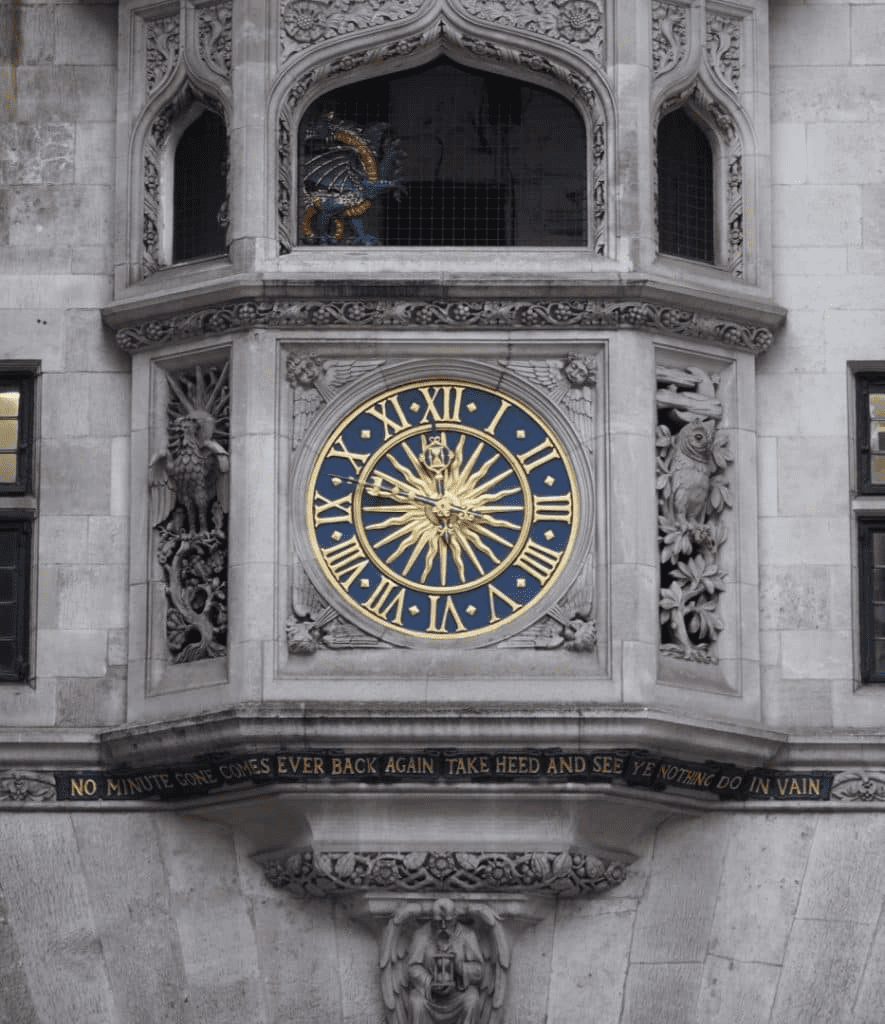
Later, clocks began to take on even greater significance. While elegance was previously demonstrated mainly through personal watches, sophistication, wealth, and style soon came to be embodied in the clocks on public buildings. This trend is perfectly reflected in the Liberty’s Clock. Although it can hardly be called one of the city’s first clocks, it is striking in its uniqueness and is a distinctive London feature. Its defining characteristics include its deep blue colour, gold stripes on the sides, and elegant hands that combine both colours. Most unique is its depiction of a radiant sun, which makes the clock stand out from others in the city.