

For many Londoners, the history of programming is often associated with the renowned IT specialist Maurice Wilkes. His work left an indelible mark on the development of modern computer science. He inspired many scientists and developers and, of course, played a crucial role in establishing London as one of the key centres for the advancement of information technology. Read more at london-future.
Maurice Wilkes was instrumental in creating the Electronic Delay Storage Automatic Calculator (EDSAC), the first full-scale, stored-program computer. He also helped to invent microprogramming.
Early Life and Education
Maurice Wilkes was born on 26 June 1913 in Dudley, Great Britain. While he was still at school, his chemistry teacher introduced him to amateur radio. The young man had a talent for physics and mathematics, which would influence the rest of his life. He was educated at the University of Cambridge, where his tutors consistently noted his analytical abilities and his skill for solving complex technical problems.
Wilkes’s interest in computing began in 1936 after he attended lectures by the English physicist and computer scientist Douglas Hartree. Just a year later, the Mathematical Laboratory was founded at Cambridge, where mechanical computers were used for scientific projects. Wilkes was invited to be a university demonstrator there, becoming the sole staff member of the new laboratory.
A Career in Computing
Maurice Wilkes’s life and work were interrupted by the Second World War. He had to leave Cambridge and was assigned to work on the development of radar and bombsight guidance systems for aircraft. In 1945, he was able to return to the Mathematical Laboratory, this time as its director.
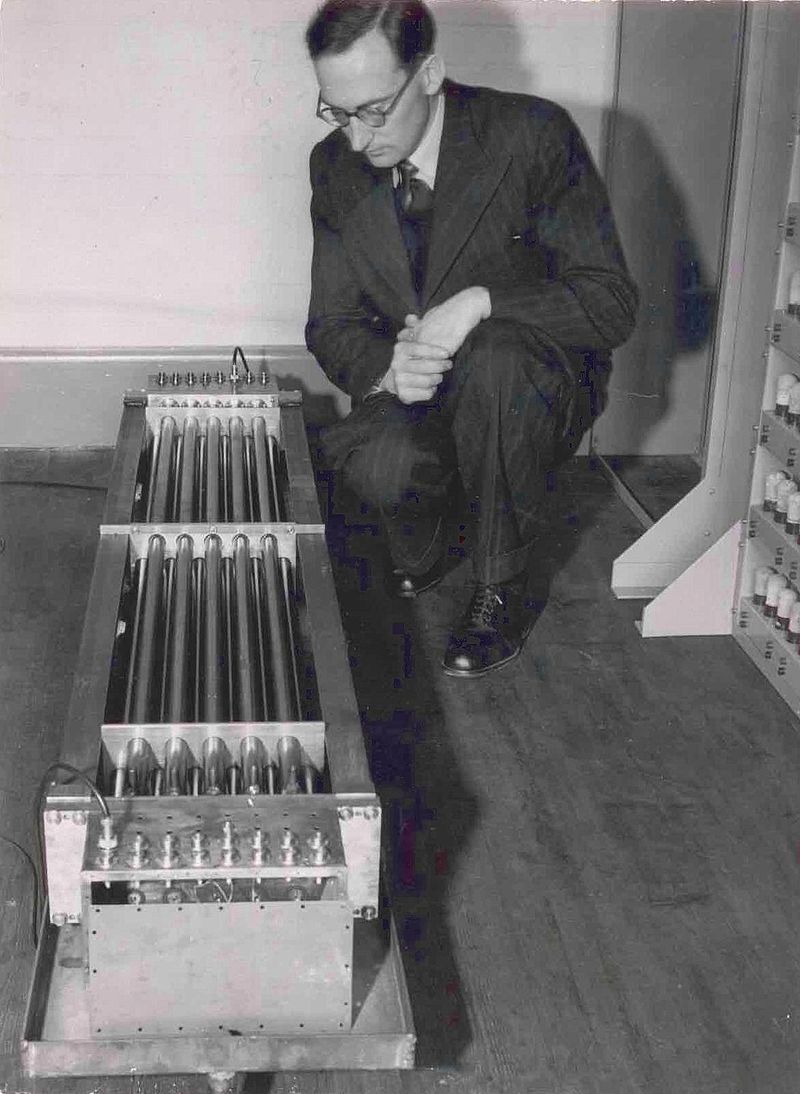
A year later, he attended a summer school on electronic computer design at the University of Pennsylvania in Philadelphia. On the journey home to England, he began working on the design for EDSAC. It is worth noting that work began in 1946, and the computer became operational in May 1949. Maurice Wilkes created EDSAC to study computer programming, as he understood just how advanced computer science would become. His computer, the EDSAC (Electronic Delay Storage Automatic Calculator), was one of the first computing devices capable of performing complex mathematical operations.
EDSAC was used to research processes in the fields of astronomy, physics, and meteorology. It was also used to develop video and scientific algorithms that formed the basis for future programming. Just as importantly, the first programming language, “EDSAC initial orders,” was created for it, which simplified the process of writing programs for the computer.
The Scientist’s Role in London’s Computer Science Development
Maurice Wilkes’s work influenced the development of IT education in Great Britain, including in London. Although the scientist worked extensively on the technical specifications and hardware of computing machines, he also made incredible efforts to ensure computer science developed as its own separate discipline. Wilkes was a recognised figure in London’s scientific circles; he conducted research in the IT field and collaborated with various specialists to create new working methods. He also served as a mentor to young programmers and engineers. Thanks to the work of Maurice Wilkes, London became a hub for the exchange of ideas and technologies in the IT sphere.
After a period working in the US, he returned to England and, from 1986 to 2002, was a consultant at the Olivetti and Oracle Research Laboratory (later AT&T Laboratories) in Cambridge. Notably, Maurice Wilkes was elected a Fellow of the Royal Society in 1956. He also received the A. M. Turing Award in 1967 and the Kyoto Prize in 1992. In 1985, he published his autobiography, “Memoirs of a Computer Pioneer.”
The man died at the age of 107, and his contribution to the development of computer science is significant. It is thanks to computer scientists like him that London and Great Britain became important centres for the global development of information technology.