

Londoners, throughout the generations, have always prioritised their children’s education, seeking out the very best schools. The process of choosing a school is an experience in itself, with families researching institutions together, followed by children attending interviews, and the shared joy of acceptance.
St Paul’s School stands as one of London’s most distinguished educational institutions. As one of the capital’s oldest schools, it has undergone numerous transformations and boasts a list of remarkable alumni. Its former pupils include famous writers and scientists who have influenced not just the city, but the entire world. Read more at london-future.
History of the School
St Paul’s School was founded in 1509 by John Colet, the Dean of St Paul’s Cathedral. Colet’s father, Sir Henry Colet, had twice served as Lord Mayor of London. As the only surviving child, John Colet inherited a substantial fortune in 1505. He used the bulk of this inheritance to endow the school, establishing it as one of the largest in England at the time.
In the 16th century, it was standard practice for the school to be managed by the church. It initially accepted 153 boys, with admission open to all, regardless of nation or country. The curriculum placed special emphasis on etiquette and literature. The number of pupils was symbolic, representing the 153 fish caught by St Peter in the Bible. The founder, Colet, intended the school to provide a humanist and Christian education. He was aided by Desiderius Erasmus of Rotterdam, the most renowned scholar of the age, who wrote textbooks for the school and helped to recruit staff.
The school was originally located in the churchyard of St Paul’s Cathedral. This building was destroyed in the Great Fire of London in 1666 but was rebuilt by 1670. The school later moved from the City of London to Hammersmith Road in 1884. In 1969, it relocated again to its current campus in Barnes, in the London Borough of Richmond upon Thames. The school has survived the plague, the Great Fire, and the Civil War. In 1870, it was one of only two day schools to be included by the Clarendon Commission in its list of the “nine great public schools” of England.
The Hammersmith and Barnes Eras
In 1884, the new school building, designed by Alfred Waterhouse, was a prominent landmark in what was then a rural area. The distinctive terracotta for the school was produced by the renowned firm Gibbs and Canning. Following a renumbering of the street, the school’s address became 153 Hammersmith Road.
In September 1939, the school was evacuated to Easthampstead Park, near Crowthorne in Berkshire, operating as a boarding school for the duration of the Second World War. It borrowed playing fields from the nearby Wellington College. Meanwhile, its London buildings were requisitioned, becoming a Home Guard HQ in July 1940 and later the headquarters of the XXI Army Group under General Bernard Montgomery. A map he used during this time is still preserved at the school. The school returned to London and resumed operations in September 1945. St Paul’s moved to its Barnes site in 1959, and the main Hammersmith buildings were demolished. Today, all that remains of the Hammersmith site are a wall, the railings, a garden store, the High Master’s Lodge (now the St Paul’s Hotel), and the Porter’s Lodge. The main buildings were demolished to make way for St Paul’s Gardens.
By 1961, it was clear the Hammersmith buildings were inadequate. This led to the development of the new 45-acre campus in Barnes, located next to Hammersmith Bridge. In the 1970s, West London College was built on 14 acres of the school’s former playing fields back at the Hammersmith site.
Leadership and Notable Alumni
One of the first High Masters was Richard Mulcaster, who wrote influential treatises on education. Another was William Lily, a renowned humanist and author of a famous Latin grammar. Under their leadership, the school established its reputation as one of the nation’s foremost educational institutions.
Throughout its long history, the school has produced many distinguished figures. These include John Everett Millais, co-founder of the Pre-Raphaelite Brotherhood, the poet John Milton, and the diarist Samuel Pepys. Alumni are known as “Old Paulines”, and many have made significant contributions to public life.
The School Today
Today, St Paul’s is considered one of the most prestigious schools in the UK. It maintains high academic standards, preparing pupils for entry into top universities like Cambridge, Oxford, Harvard, and Yale. The school also provides financial support (bursaries and scholarships) for talented boys who meet the criteria. The school seeks to select pupils who are purposeful, inquisitive, and capable of independent thought.
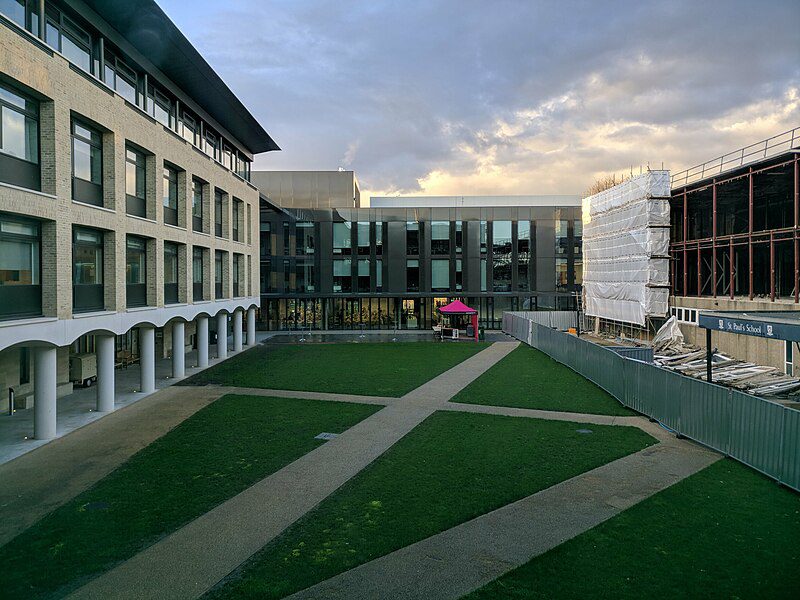
The school is situated in a picturesque part of London, set within 45 acres of green space on the banks of the River Thames. Its campus is unique among the capital’s schools, boasting facilities that include a boat club, a theatre, an art gallery, a cricket school, and a concert hall. In 2020, a major redevelopment of the Senior School was completed. The new buildings feature a central atrium, the Colet Hall, a chapel, a dining hall, the Kayton Library, and classrooms overlooking the river, in addition to extensive playing fields.
St Paul’s School continues its long tradition of educating boys aged 13 to 18. Through its high-quality education, pupils gain the knowledge and skills needed for a successful future.