

London is a city of contrasts, where the contemporary seamlessly blends with the traditional, and the polished meets the provocative. Major events, social shifts, and innovations are often mirrored in its art. In the UK capital, you can embrace your inner child, build a successful business, or bring your most creative visions to life. London serves as a vast creative hub for photographers, designers, and artists, whose influence is visible even on the city’s architecture. But what symbols are hidden within these wall paintings? Who creates them, and what makes this form of art so unique? Discover more at london-future.
Diversity and Multi-faceted Art
London boasts an incredibly diverse range of graffiti. While some pieces are conceptual, they often feel effortless and accessible. For instance, a mural beneath Hungerford Bridge depicts the evolution of the human form, tracing a journey from foetus through childhood and adolescence to adulthood. While it may not carry a heavy philosophical message, the colourful progression is a captivating sight. Meanwhile, the Leyton area was transformed by a community-led project involving local residents and shop owners. Eight buildings were repainted with vibrant patterns, refreshing the neighbourhood and brightening local life during the challenges of the pandemic.
However, much of London’s street art is created with a specific intent. Artists frequently use their work to deliver a message to the public, imbuing their characters and imagery with symbolic weight. In 2018, for example, a mural appeared on the wall of the Lord Morpeth pub to commemorate the centenary of women’s suffrage. Another striking example is the Hackney Peace Carnival mural near the Eastern Curve Garden. This detailed work depicts local residents marching in protest against war and nuclear weapons.
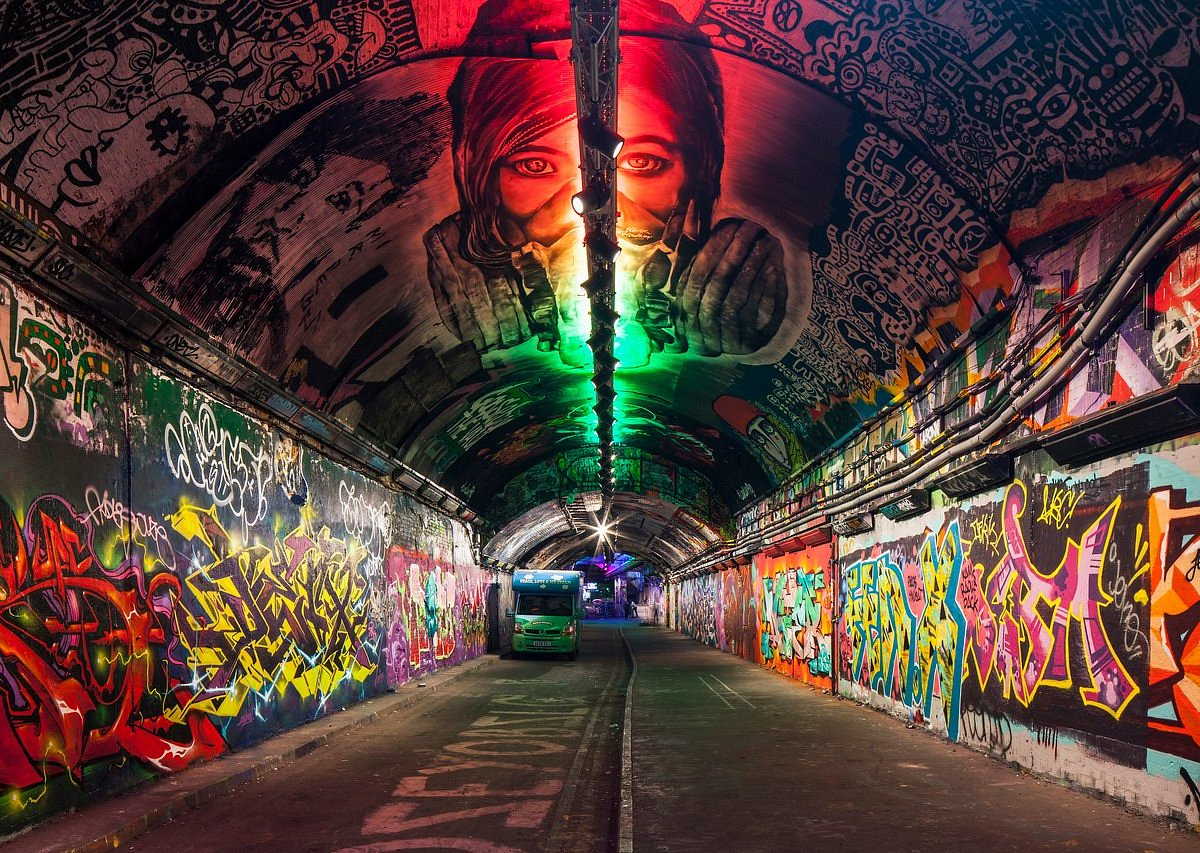
While such examples are scattered across the capital, one location stands out as a legal haven for graffiti: Leake Street. This 300-metre tunnel is a thriving creative space where artists can often be seen at work. The site perfectly illustrates the ephemeral nature of street art. The tunnel walls serve as an ever-changing canvas where nothing is permanent. Pieces vanish, others are modified, and new masterpieces constantly emerge. This reflects the reality of street art across the city—one never knows if a mural will stand the test of time.
Street Art and the Enigma of Authorship
London’s graffiti is a unique phenomenon with its own set of rules, particularly regarding authorship. No discussion of the scene is complete without mentioning Banksy, whose work began appearing on London’s streets in the early 2000s and quickly gained global fame. Even Leake Street is often referred to as the “Banksy Tunnel,” as it was he who first popularised the space by organising the Cans Festival there in 2008.
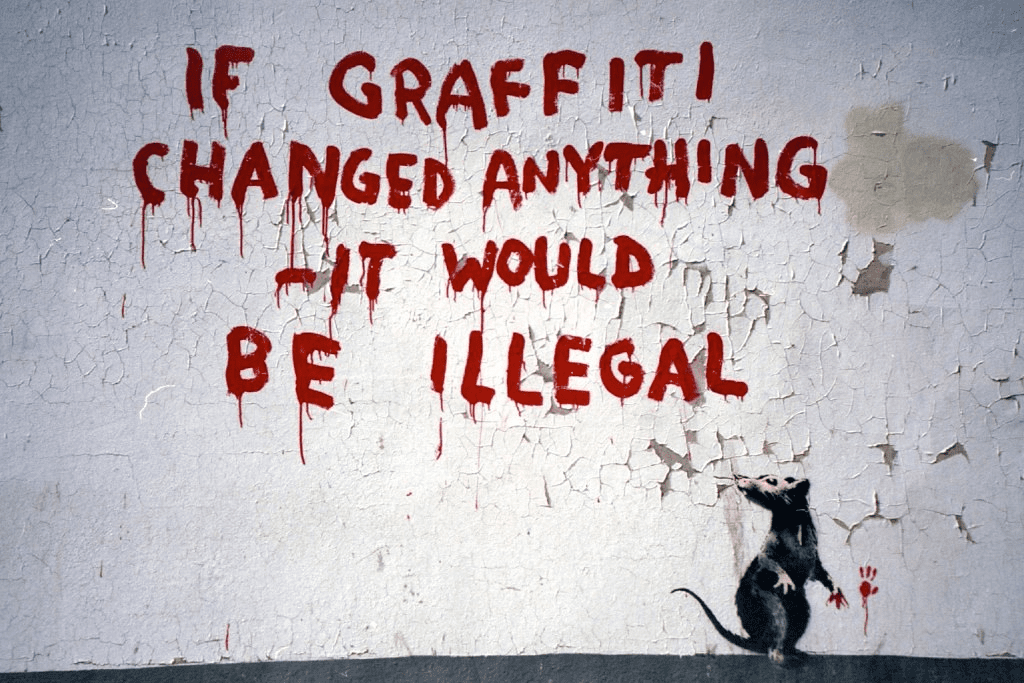
As a political activist, Banksy’s work often features satirical commentary on social and political issues. Pieces such as “If Graffiti Changed Anything It Would Be Illegal” and “Tesco Kids” serve as sharp critiques of modern society. Naturally, his true identity remains a subject of intense debate and has never been officially confirmed. This anonymity is a hallmark of the street art world; due to the often-illegal nature of the work, many creators prefer to remain in the shadows.