

In Jewish tradition, a cemetery is not just a burial place but a sacred memorial, recalling the achievements of one’s ancestors. It offers a place to pray for their souls and to learn from their example. In Great Britain, Willesden Jewish Cemetery came to fulfil this role. As one of London’s ‘Magnificent Seven’ cemeteries, it reflects the cultural dialogue between the Jewish community and wider British society. Read more at london-future.
The Founding and Development of Willesden Jewish Cemetery
In the mid-19th century, the mass migration of Jewish people to the western suburbs of Great Britain created a need for new burial land. With Willesden growing rapidly, the community decided to establish a new cemetery with space for 35,000 graves. Meanwhile, 1870 saw the formation of the United Synagogue, a charitable organisation that serves the British Jewish community. In 1873, Willesden Jewish Cemetery became its first project. The architect and surveyor Nathan Joseph arranged the purchase of the land from the Church of England, and the organisation initiated its opening.
The first funeral at Willesden Jewish Cemetery took place before its construction was even complete. In accordance with Jewish custom, it was held within 24 hours of death, but it was arranged hastily at the specific request of the deceased. The deceased was a well-known merchant named Samuel Moses. This sparked a major scandal, as the religious community had not yet had time to declare the cemetery officially open. In 1890, Nathan Marcus Adler, the first Chief Rabbi of the United Synagogue and the British Empire, was also buried in the cemetery. His grave is located in a prominent position along the central avenue.
Initially, Willesden Jewish Cemetery served the established Jewish families of Central and West London. In the early 20th century, the capital’s Jewish population swelled with newcomers from Eastern Europe and Russia. In 1907, an extension called the ‘New Ground’ was built at the cemetery, accommodating the needs of this new wave of arrivals. Shortly after, the architect Lewis Solomon designed a new entrance lodge in a classical late-Renaissance, Queen Anne style. Meanwhile, in 1929, a new assembly space in front of the Prayer Hall was created, designed by architect Harry Ford.
During the Second World War, Willesden Jewish Cemetery suffered damage from air raids. Nearby industrial sites and railway lines were repeatedly targeted by German aircraft. In 1941, a direct hit on the cemetery destroyed its only mausoleum. By 1945, with burial space almost full, the United Synagogue began searching for a new site. The most prestigious plots were reserved only for the burial of the community’s most prominent philanthropists and benefactors.
In 1961, the Commonwealth War Graves Commission erected the first national Jewish war memorial in Great Britain at Willesden Jewish Cemetery. This project, designed by Ralph Hobday, commemorates Jewish service members who died in the two World Wars. In 2015, the United Synagogue received a grant from the UK’s National Lottery Heritage Fund to restore the cemetery. Celebrating its 150th anniversary, it also opened the ‘House of Life’ to the public within the burial grounds.
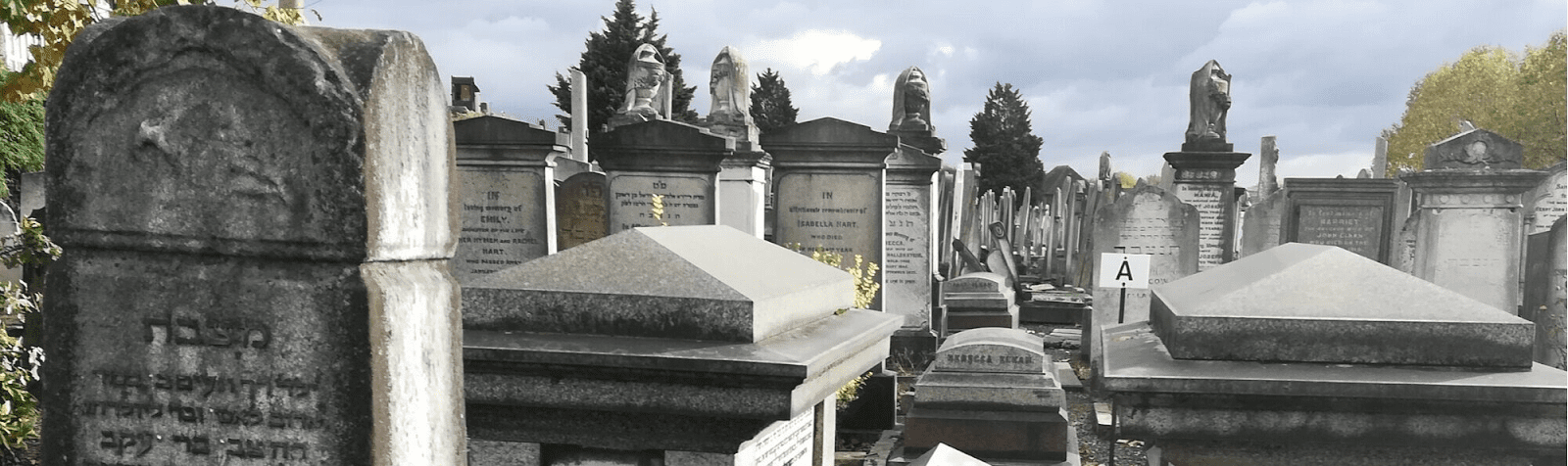
Willesden Jewish Cemetery
Recognition and Significance of Willesden Jewish Cemetery
Willesden Jewish Cemetery remains a landmark site, reflecting the long history of the Jewish community in Great Britain. Its Grade II listed monuments include the graves of Maximilian Eberstadt, Rosalind Franklin, and Mayer de Rothschild. Through exhibitions, art installations, and various events at the ‘House of Life’, visitors can experience the atmosphere of the site, remember loved ones, and reflect on the themes of life and death.
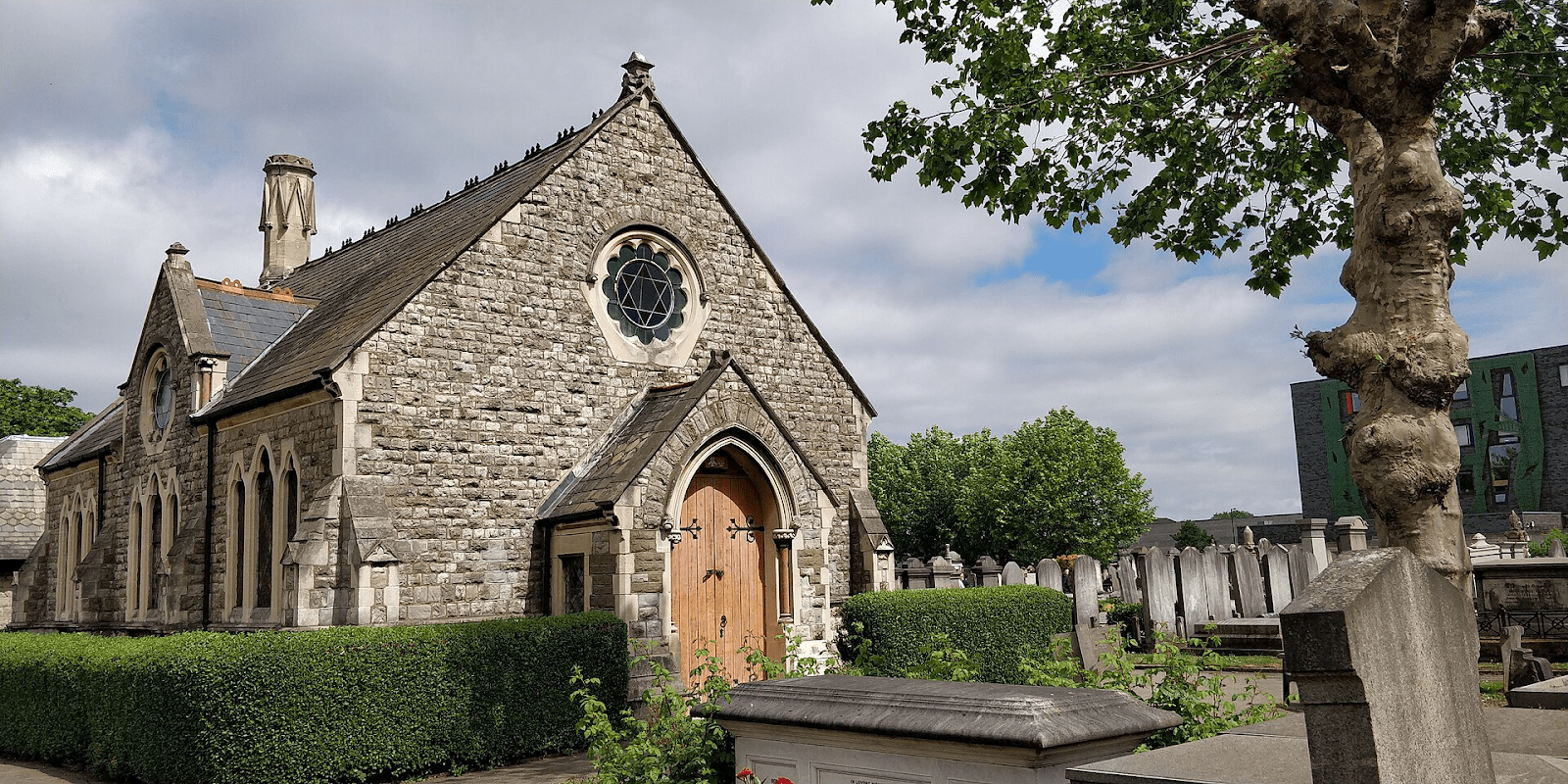
Wikipedia