

London, the capital of Great Britain, is a city steeped in rich history and cultural heritage. It is celebrated for its unparalleled architecture, which draws tourists from all over the world. These sites inspire awe with their artistic decoration and grandeur.
The sacred sites of London, found throughout the city, are particularly impressive. In the City of London alone, there are around 50 churches, many considered architectural masterpieces of great historical significance. Read more at london-future.
St. Paul’s Cathedral
St. Paul’s Cathedral, London’s most famous church, was built in the 17th century. It stands in the very heart of the capital on Ludgate Hill, the highest point in the City of London. The building, with its towering dome, is Grade I listed. It was designed in the English Baroque style by Sir Christopher Wren as part of the major rebuilding programme following the Great Fire of London. The earlier “Old St Paul’s Cathedral,” which was destroyed in the fire, had been the centre of medieval and early modern London life.
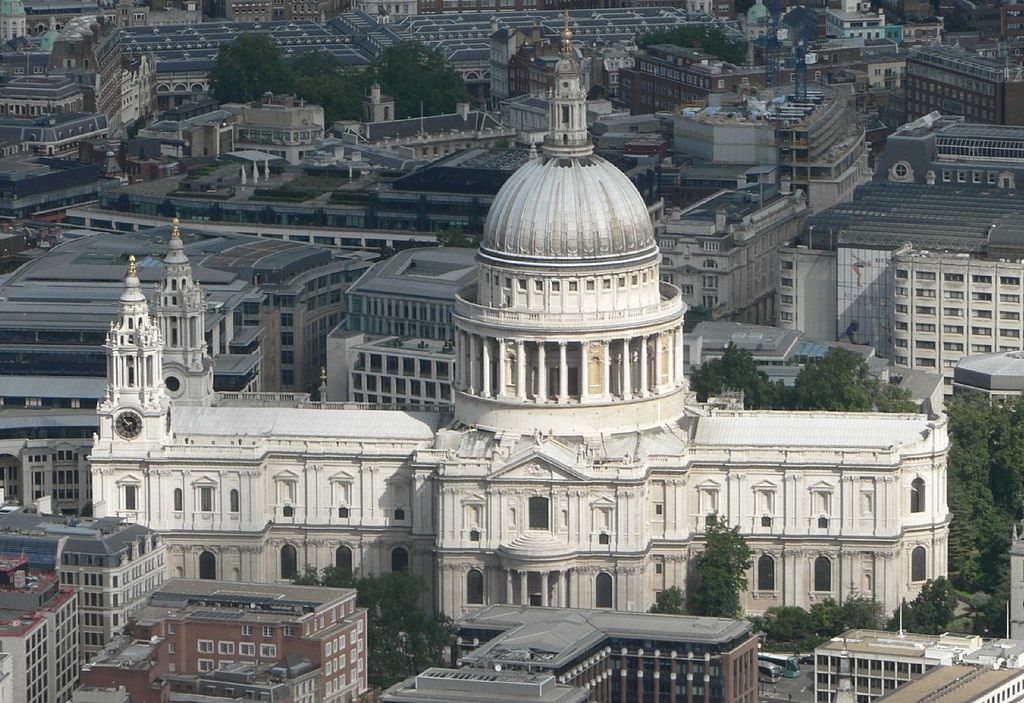
St. Paul’s is one of London’s most iconic landmarks. Its magnificent dome, one of the largest in the world, dominates the city skyline. The cathedral is the second-largest church building in Great Britain, after Liverpool Cathedral. It is a working church with daily prayers and services. The cathedral has also been the setting for major national events, including the wedding of Prince Charles and Lady Diana Spencer and the state funeral of Winston Churchill.
Inside, you can admire stunning frescoes, intricate carvings, and beautiful woodwork. The Golden Gallery offers breathtaking views over the city. At Christmas and Easter, the cathedral is filled with live music. There is an admission fee for tourists, but worshippers attending services or visiting for private prayer are not charged. The nearest Tube station, ‘St Paul’s’, is located right next to the cathedral.
Westminster Abbey
Since 1066, Westminster Abbey has been the coronation church for English and British monarchs and their final resting place. Although little is known about the church’s origins before the 10th century, it is certain that an abbey of Benedictine monks was established here. The first major building was commissioned by King Edward the Confessor in the 1040s, while the present church was begun in 1245. The monastery was dissolved in 1559, and Queen Elizabeth I made it a ‘Royal Peculiar’ – an Anglican church under the direct jurisdiction of the monarch.
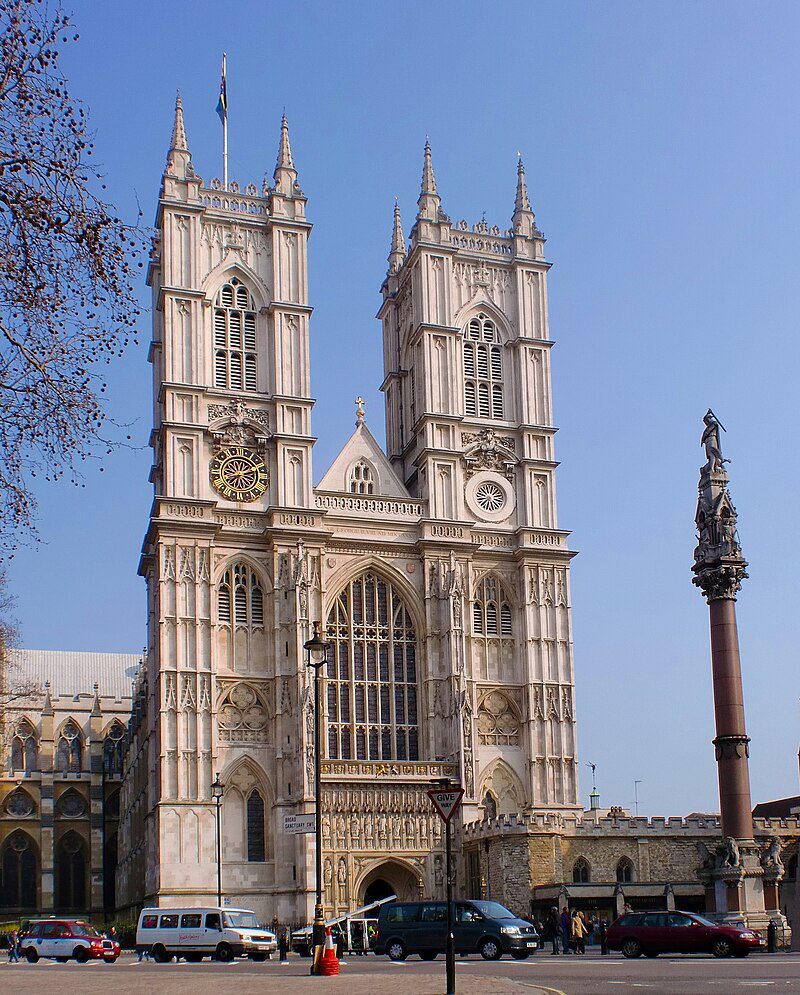
It is one of the finest examples of Gothic architecture and never fails to impress visitors. The Henry VII Chapel, located in the eastern part of the church, is a masterpiece of Perpendicular Gothic architecture. The Abbey is the burial place of many of the nation’s most famous figures: monarchs, prime ministers, poets, actors, musicians, and military leaders. Sir Isaac Newton, Charles Darwin, and William Morris are all interred here. The Abbey is also the setting for royal weddings, including the marriage of Prince William and Kate Middleton in 2011.
There is an admission charge for visitors to the Abbey. Members of the clergy may be able to arrange a church pass.
Temple Church
Temple Church is one of London’s most beautiful churches. It was built in the 12th century by the Knights Templar. The church consists of two parts: the Round Church and the Chancel. The Round Church was consecrated in 1185 by the Patriarch of Jerusalem. It was designed to resemble the circular Church of the Holy Sepulchre in Jerusalem. This space is mystical and has beautiful acoustics for singing.
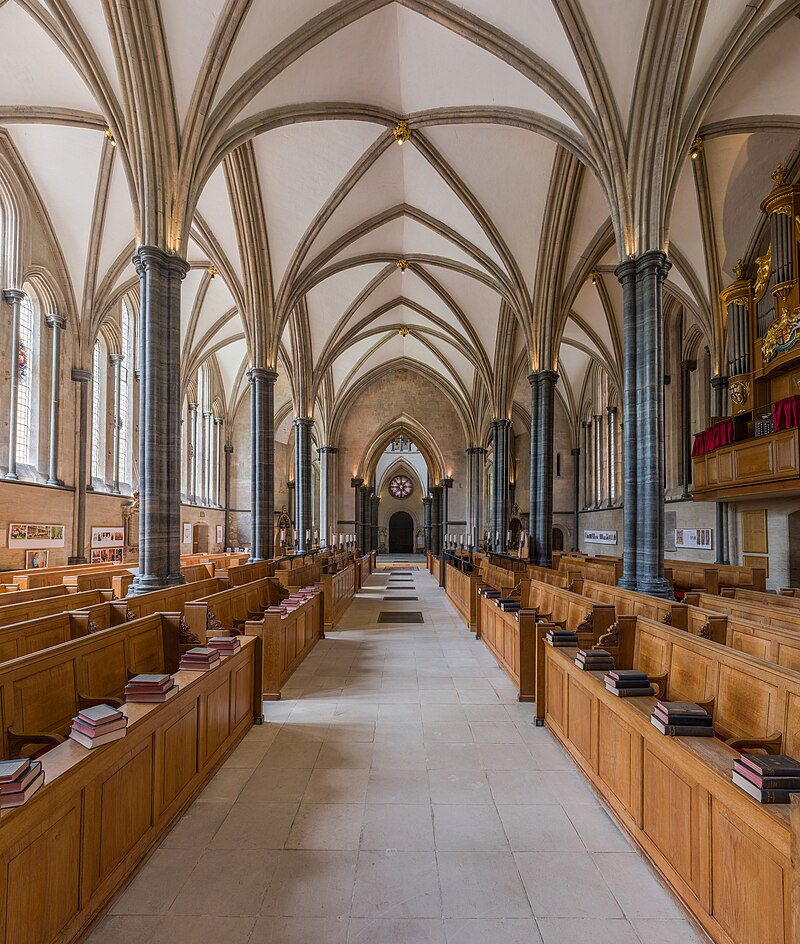
The church was severely damaged by bombing during the Second World War and has since been extensively restored and rebuilt. The church has played an important role in England’s legal history and is part of London’s legal quarter. The area around the church is still known as ‘the Temple’. The Master of the Temple is the Reverend Robin Griffith-Jones, appointed in 1999. He regularly holds lunchtime lectures that are open to the public. ‘Temple’ Tube station is conveniently located near the church, making it easy for tourists to visit.
Southwark Cathedral
The Cathedral and Collegiate Church of St Saviour and St Mary Overie is situated on an ancient river crossing of the Thames. For many centuries, this was the only entrance to the City of London located over the river. Historians suggest a community of nuns was present here in the 7th century. The main cathedral was built in the 13th century and is known for its beautiful stained-glass windows and architectural details. It has been a place of Christian worship for over 1,000 years, but it only gained cathedral status with the creation of the Diocese of Southwark in 1905.
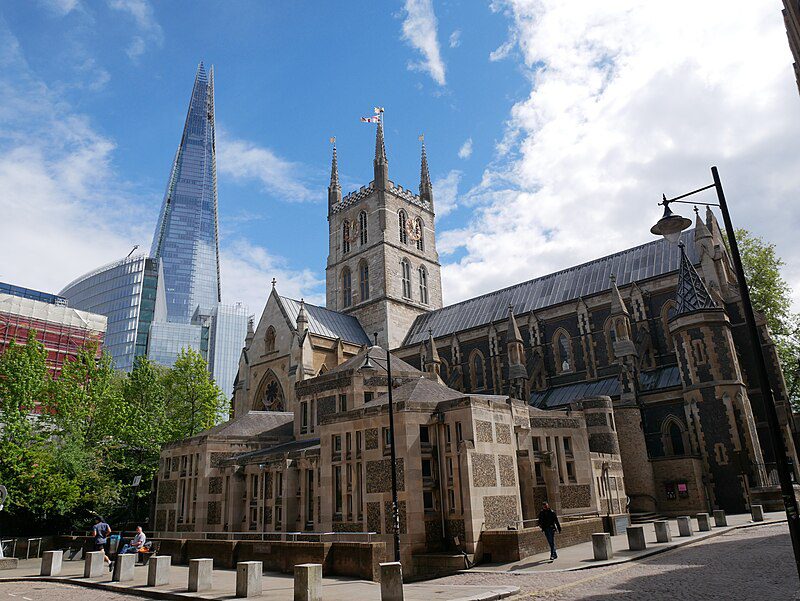
Between 1106 and 1538, it was the church of the Augustinian monastery of Southwark Priory. After the Dissolution of the Monasteries, it became a parish church and was part of the Diocese of Winchester until 1877, when it was transferred to the Diocese of Rochester. The current building largely retains the form of the Gothic structure built between 1220 and 1420, although the nave is a 19th-century reconstruction.
In 2000, new buildings designed by Richard Griffiths were added to the north of the cathedral. These include conference rooms, a library, an education centre, a shop, and a refectory. The cathedral also has a strong association with William Shakespeare, whose brother Edmund is buried here.
All Hallows-by-the-Tower
Located next to the Tower of London, All Hallows-by-the-Tower was founded in 675 AD and is considered the oldest church within the City of London. A Saxon arch from this original church can still be seen today. In the crypt below, there is a 2nd-century Roman pavement, discovered in 1926, which is a tangible sign of the city’s life for nearly 2,000 years.
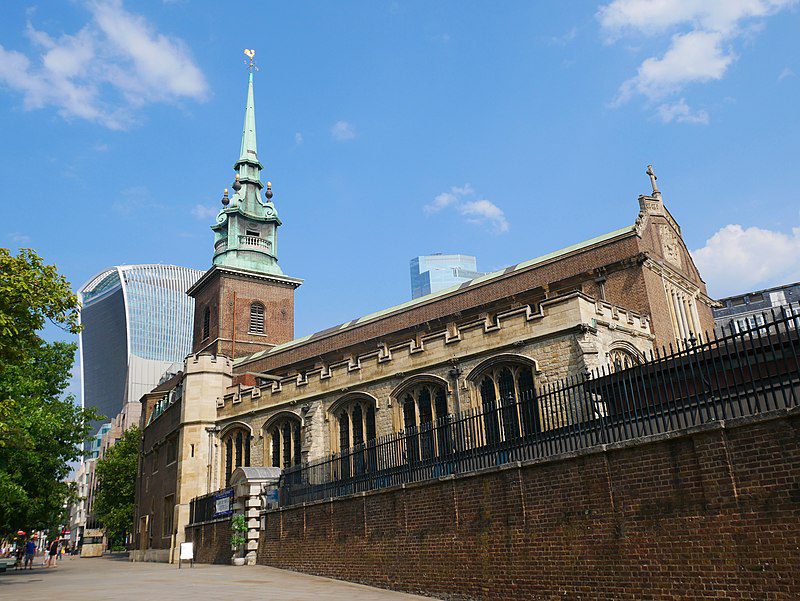
The church received the bodies of many of those beheaded on nearby Tower Hill, who were brought here for temporary burial after their execution. The Great Fire of London in 1666 started near the church, but the building was saved, preserving many historical artefacts, including Roman mosaics and the Saxon arch. However, the church was badly damaged by bombing during the Second World War, leaving only the walls and tower standing. It was rebuilt after the war and rededicated in 1957. The vicar at the time was “Tubby” Clayton, founder of the Toc H movement.
The church has a set of chimes, which were restored to working order in the 1970s under the direction of Desmond Buckley and Philip Bluett, who was the priest at the time. Londoners and visitors are also familiar with the museum located within the church, which displays exhibits reflecting the history of London.
St. Bride’s Church
St. Bride’s Church is an Anglican church on Fleet Street in the City of London. The original building was almost completely destroyed during the Great Fire of London. The current structure was designed by Sir Christopher Wren in 1672. The church was again gutted by bombing during the London Blitz in 1940 and was reconstructed in the 1950s.
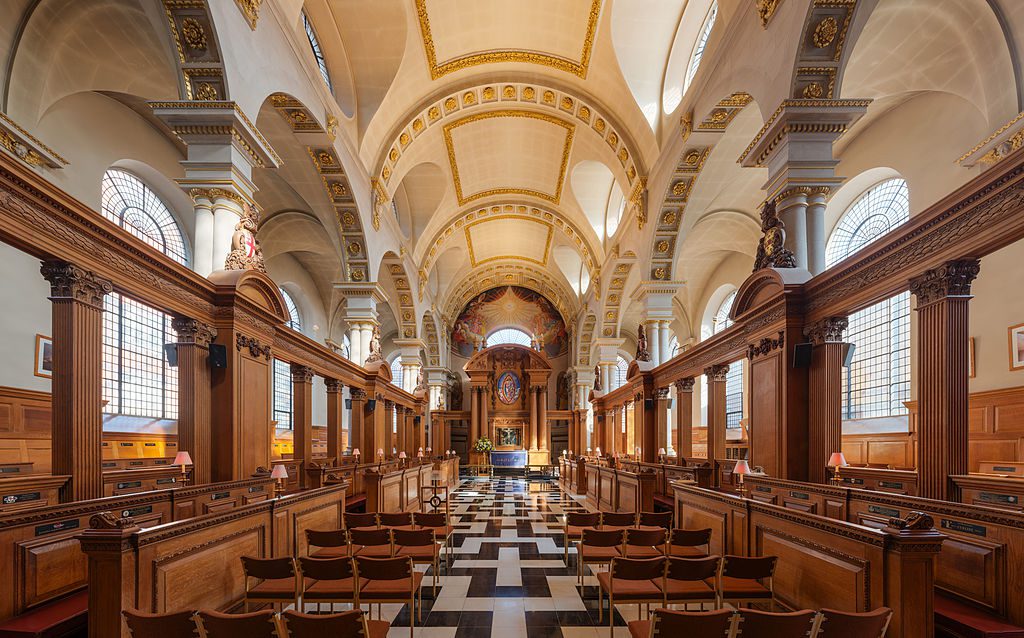
Due to its location on Fleet Street, the traditional home of British journalism, it is often called the “Journalists’ Church.” The church is a distinctive London landmark, visible from several points in the city. It is famous for its “wedding cake” spire, which stands 69 metres (226 feet) tall. Beneath the church are crypts that are open to visitors, containing archaeological finds that chart the history of the capital.
In conclusion, it is difficult to describe all of the city’s holy sites. They have survived disasters, wars, and social change, yet these churches still stand, reminders of London’s grandeur and spiritual strength.